
Expansive Soils 101: How They Can Damage Your Home's Foundation

If you've noticed hairline cracks running along your drywall, a door that suddenly won't latch, or a driveway slab that seems to be tilting, expansive soil could be the culprit. Across the Bay Area and Sacramento Valley, clay-rich soils shrink and swell with the seasons — and that movement is one of the most common, and most misunderstood, threats to a home's foundation.
What Are Expansive Soils?
Expansive soils contain clay minerals — often montmorillonite or similar smectite clays — that absorb water and swell dramatically during wet months, then shrink and crack as they dry out over summer. This cycle repeats every year, and the resulting ground movement can be substantial: some clays change volume by 10% or more between saturated and dry conditions.
Why This Matters in the Bay Area and Sacramento Valley
Much of our region sits on old marine and alluvial clay deposits — the same soils that make hillsides slick after a storm. Combine that geology with our pronounced wet-to-dry seasonal swing, and you get soils that are constantly moving beneath foundations, slabs, and pavement, often in ways that aren't obvious until real damage appears.
How Expansive Soils Damage Residential Structures
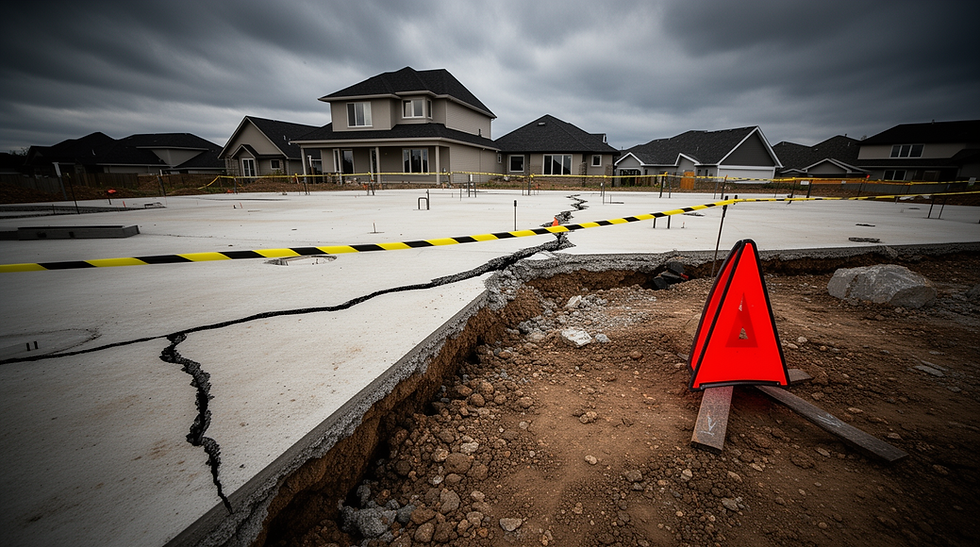
Shrink-swell movement doesn't happen evenly across a building footprint, which is exactly why it's so damaging. Common effects include:
Foundation cracking, particularly diagonal cracks near corners, windows, and door openings
Uneven or bouncy floors as slab-on-grade sections heave or settle unevenly
Doors and windows that stick, bind, or won't latch the way they used to
Cracked stucco, drywall, and tile, especially at wall-to-ceiling junctions
Broken or misaligned plumbing and utility lines running beneath the slab
Heaving or cracking of driveways, walkways, and patio slabs
Warning Signs to Watch For
Most expansive soil damage develops gradually, so it's worth checking for these signs at least once a year, especially after the first heavy rains:
New or widening cracks, particularly diagonal ones or those wider than about 1/8 inch
Gaps opening up between walls and ceilings, or along baseboards
Doors or windows that used to operate smoothly and now don't
Sloping, uneven, or springy floors
Water pooling near the foundation after rain instead of draining away
How We Assess and Mitigate the Risk
A proper geotechnical evaluation starts with subsurface exploration — borings or hand auger test pits, depending on the site — followed by laboratory testing to quantify how reactive the soil actually is. Atterberg limits testing (ASTM D4318) and expansion index testing (ASTM D4829 / UBC 18-2) tell us the plasticity and expansion potential of the on-site clay, which drives the foundation design. Depending on those results, we typically recommend one or more of the following:
Post-tensioned slab-on-grade foundations engineered for the site's specific expansion index
Deepened or belled perimeter footings that extend below the active (moisture-affected) zone
Moisture barriers and capillary breaks beneath slabs
Presaturation of the subgrade before the slab is poured, to reduce future swell
Positive drainage and grading that moves water away from the foundation year-round
Root barriers where large trees sit close to the foundation, since root water extraction can intensify shrink-swell cycling
When to Call a Geotechnical Engineer
The best time to address expansive soil risk is before you build — during design for new construction, an ADU, or a room addition, a soils report with expansion index testing lets your structural engineer size the foundation correctly from the start. For existing homes, if you're seeing cracking, sticking doors, or uneven floors, an evaluation can determine whether expansive soil (versus settlement, plumbing leaks, or another cause) is behind it, and what the most cost-effective fix looks like.
If any of these warning signs sound familiar, or you're planning new construction on Bay Area or Sacramento Valley clay, we're happy to help. AK Geotech provides soil testing, expansion index analysis, and foundation design recommendations tailored to your specific site.



Comments