
Liquefaction in the Bay Area: What Homeowners and Builders Need to Know

The 1989 Loma Prieta earthquake is still the clearest reminder of what liquefaction can do to a Bay Area neighborhood. In San Francisco's Marina District, buildings built on loose sandy fill sank, tilted, and in some cases collapsed — while nearby buildings on firmer ground came through largely unscathed. That difference wasn't luck. It was geology, and it's still relevant to anyone building or buying on the Bay's low-lying ground today.
What Is Liquefaction?
Liquefaction happens when loose, saturated, sandy or silty soil temporarily loses its strength during strong earthquake shaking. Water pressure builds up between the soil grains faster than it can drain away, and the soil essentially behaves like a liquid for a short period. Foundations, pipelines, and pavement supported by that soil can sink, tilt, or float, depending on what's pushing down or floating up nearby.
Why the Bay Area Is Particularly Exposed
A lot of Bay Area development sits on ground that was never solid to begin with: engineered and hydraulic fill placed along the shoreline over the last century, soft Bay Mud, and young alluvial deposits in valley floors. These materials are loose, often saturated by a shallow groundwater table, and sit directly above one of the most seismically active regions in the country — the combination that makes liquefaction assessment essential rather than optional here.
How Liquefaction Damages Structures
Unlike shaking damage, which is roughly uniform across a site, liquefaction damage is driven by how the ground itself deforms. Typical effects include:
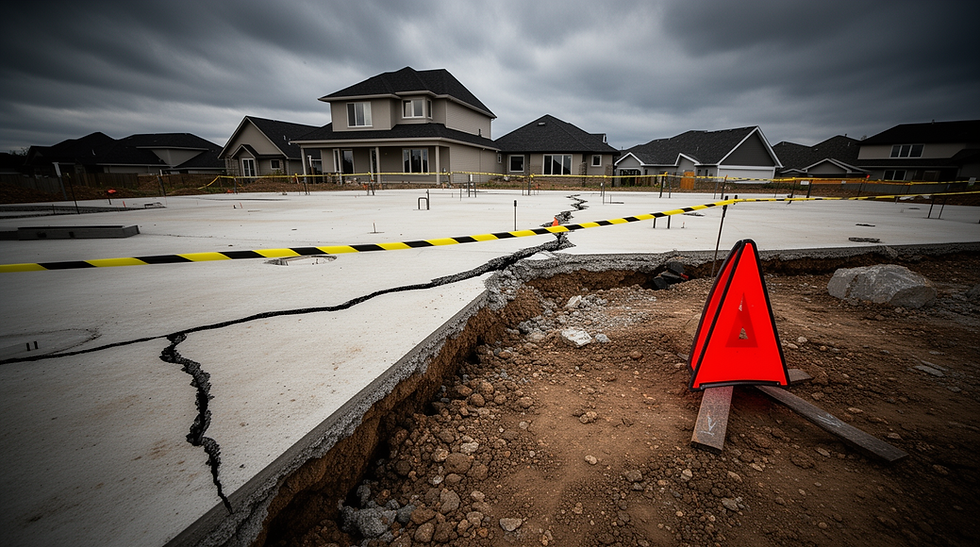
Uneven settlement, where one part of a foundation sinks more than another, cracking slabs and framing
Bearing capacity loss, allowing a structure to tilt or partially sink into the ground
Lateral spreading, where liquefied soil on a slope or near a waterway shifts sideways, dragging foundations with it
Sand boils and ground cracking at the surface, along with damage to buried utilities and pipelines
Uplift of lightweight buried structures, such as pools and underground tanks, as liquefied soil temporarily behaves like a dense fluid
Is Your Site in a Mapped Liquefaction Zone?
The California Geological Survey (CGS) publishes official Seismic Hazard Zone maps that identify areas with liquefaction potential, and ABAG maintains a complementary hazard viewer for the Bay Area. Being inside a mapped zone triggers specific requirements: a site-specific geotechnical investigation is typically required before a city or county will approve a building permit. Being just outside a mapped zone doesn't automatically mean the risk is zero — the maps are regional screening tools, not a substitute for site-specific data.
How We Evaluate and Mitigate Liquefaction Risk
A liquefaction evaluation starts with subsurface exploration, usually borings or cone penetrometer testing (CPT), to characterize soil density, gradation, and groundwater depth at your specific site. We then run standard liquefaction triggering analyses (commonly Boulanger-Idriss or Seed-Idriss methods) to estimate the factor of safety against liquefaction and the expected settlement. Depending on the results, mitigation options include:
Ground improvement techniques such as densification (vibro-compaction, deep dynamic compaction) to increase soil density before liquefaction can occur
Deep foundations, such as piles or drilled piers, that bypass the liquefiable layer and bear on competent soil or rock below
Stiffened mat or post-tensioned foundations designed to bridge over anticipated differential settlement
Ground improvement columns (stone columns or soil-cement columns) to provide both densification and improved drainage
When to Get an Evaluation
If your property sits in a mapped liquefaction zone — which includes large portions of San Francisco's eastern shoreline, Oakland, Alameda, San Jose's Guadalupe River corridor, and other low-lying areas around the Bay — plan for a geotechnical investigation early in design, whether you're building new, adding an ADU, or evaluating an existing home before purchase. Catching liquefaction risk during design is far less costly than addressing settlement damage after the fact.
If you're planning construction on Bay Area fill or alluvium, or just want to know where your property stands relative to the mapped hazard zones, we're happy to help with a site-specific liquefaction assessment.



Comments