
Slope Stability Hazards in California: What Hillside Property Owners Should Know

California's hillsides look stable right up until they aren't. Every winter of heavy rain, and every significant earthquake, reminds property owners across the state that slope stability isn't a one-time checkbox — it's an ongoing condition of the ground itself. Whether you're building new, adding an ADU, or just own a home on a hillside lot, understanding what actually drives slope failure is the first step to protecting your investment.
What Causes Slope Instability in California
Slope failures rarely have a single cause. Most are the result of several factors stacking up at once:
Weak or adversely oriented bedding — rock layers, faults, or shear zones that dip toward the slope face, giving a failure surface somewhere to slide along
Saturation from rainfall — water infiltrating a slope adds weight, raises pore pressure, and reduces the soil's internal friction, which is why most California landslides happen during or just after wet winters
Seismic shaking — an earthquake can trigger a slope that was already marginally stable, especially on slopes with loose colluvium or liquefiable material at the toe
Human factors — cut-and-fill grading, over-steepened slopes, blocked or concentrated drainage, leaking pools and irrigation, and vegetation removal (including after wildfire) all reduce a slope's margin of safety
California's Landslide-Prone Geology
Slope stability risk isn't evenly distributed across the state — it's tied directly to what's under the hillside. Across much of the Bay Area and Coast Ranges, hillsides are underlain by the Franciscan Complex, a geologically complicated mix of sandstone, shale, chert, and serpentinite that formed through tectonic mixing rather than orderly deposition. That mixing means bedding and shear surfaces can run in almost any direction, including straight out of the slope face. Serpentinite terrain in particular tends to weather into weak, clay-rich material that's especially prone to creep and deep-seated landslides. Add a mantle of colluvium — loose material that has already moved downslope once before, sometimes centuries ago — and you have terrain where the ground itself has a documented history of failure, whether or not it's visible at the surface today.
Warning Signs of a Failing Slope
Slopes rarely fail without warning. The signs are often subtle and slow, which is exactly why they get missed until damage is already underway:
New or widening tension cracks in the ground, especially arc-shaped cracks near the top of a slope
Tilting trees, fence posts, or utility poles — trunks and posts that used to be vertical starting to lean
Doors and windows that suddenly stick or won't close properly
New springs, seeps, or unusually damp ground appearing where the slope was previously dry
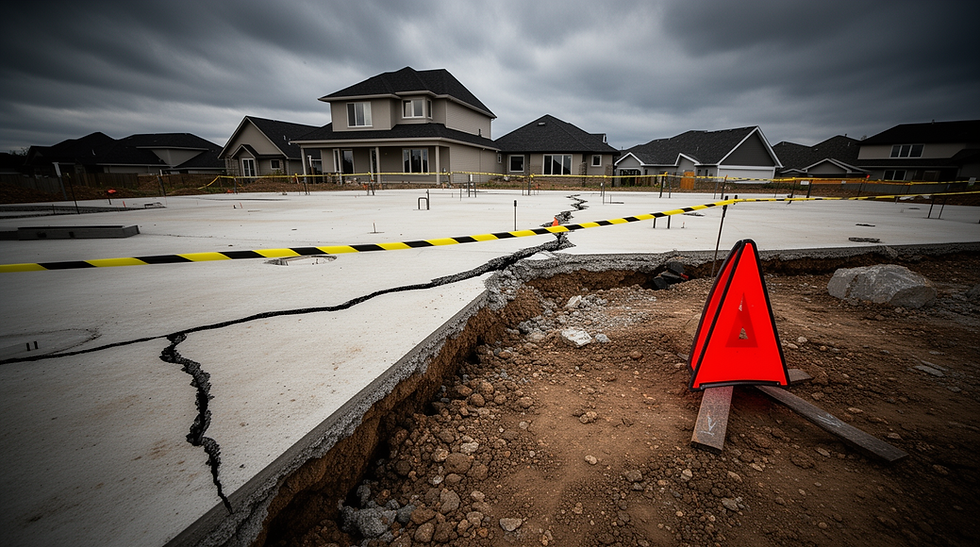
Cracked slabs, foundations, or retaining walls, particularly cracks that continue to grow over weeks or months
Slow, gradual downslope movement of soil or pavement — sometimes called slope creep
Any one of these on its own isn't necessarily an emergency, but seeing more than one together, or seeing any of them worsen over time, is a strong signal to get a geotechnical engineer out to look at the slope.
How Slope Stability Is Evaluated
A proper slope stability evaluation starts in the field, not at a desk. That means subsurface exploration — borings, test pits, or hand-augered holes depending on access — to identify the soil and rock units present, locate groundwater, and find any existing failure surfaces. Back in the office, that data feeds into slope stability analysis using limit equilibrium methods, run under both static conditions and seismic (pseudo-static) loading to confirm the slope has an adequate factor of safety in an earthquake as well as day to day. For sites with an active or ancient landslide, this typically also means back-analyzing the existing failure surface to understand what strength parameters are actually governing the slope, rather than relying on generic published values.
Mitigation and Design Options
When a slope doesn't meet the required factor of safety, there are several established ways to bring it into compliance, and the right choice depends heavily on the specific site:
Drilled piers or caissons extending below the failure surface into competent material, often used to support structures on or above an active landslide
Retaining walls or soldier pile walls to resist lateral earth pressure and hold back a cut or fill slope
Subdrainage systems to intercept and remove groundwater before it saturates the slope
Regrading or unloading the top of the slope and buttressing the toe to improve the overall geometry
Setbacks from the slope crest or toe, sized specifically for the site rather than a generic code minimum
In many cases the most cost-effective fix is also the simplest: controlling where water goes. A well-designed drainage plan alone resolves a meaningful share of the slope stability problems we see on residential sites.
Get a Site-Specific Evaluation
Published landslide inventory maps and regional hazard zones are a useful starting point, but they're not a substitute for site-specific data — plenty of unmapped slopes have failed, and plenty of mapped ones perform fine with the right design. If you're planning to build on a hillside lot, add an ADU above or below existing structures, or you're already seeing warning signs on a slope you own, AK Geotech provides slope stability investigations, drilled pier design, and construction observation across California. Reach out to talk through what your site needs.
Sources: California Geological Survey landslide hazard mapping and guidance; standard limit-equilibrium slope stability methodology (including seismic pseudo-static analysis) as applied to California hillside sites.



Comments