
Why Every ADU Needs a Geotechnical Investigation Report Before You Break Ground

If you're planning to build an Accessory Dwelling Unit (ADU) in California, there's a good chance your city or county will ask for a geotechnical investigation report before they'll approve your building permit. It's easy to see this as just another line item on an already long checklist, but a geotechnical report isn't paperwork for paperwork's sake. It's the study that tells your engineer, your contractor, and your building department exactly what's underneath your backyard, and whether the ground can safely support the foundation you're planning to build on it.
Here's why this report matters so much for ADU projects specifically, and what actually goes into producing one.
ADUs put new weight on ground that was never evaluated for it
Most residential lots in California were graded and engineered decades ago, for a single primary structure sited in a specific spot. An ADU adds a second, independently founded building, often in the backyard, near property lines, mature trees, slopes, or existing utility lines, on soil that has never been formally tested. Local building departments know this, which is why a geotechnical report is a standard requirement for ADU permitting in most California jurisdictions, especially where the region is known for expansive clay soils, fill material, sloped lots, or elevated seismic hazard.
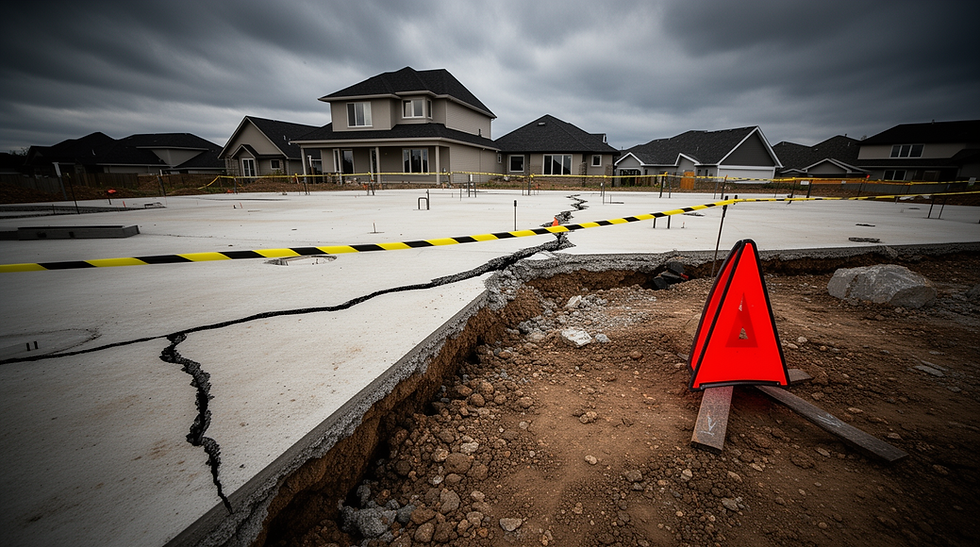
Without site-specific data, a foundation design is really just a guess. With it, your structural engineer can design a foundation sized correctly for your soil conditions instead of over-building, which wastes money, or under-building, which risks cracking, settlement, or worse.
What a geotechnical investigation actually evaluates
A proper investigation goes well beyond digging a hole and looking at the dirt. At AK Geotech, our ADU investigations typically include:
Document and records review - existing geologic maps, prior site reports, and any available data on the parcel's history and grading.
Site reconnaissance - a walk of the property to note slope conditions, drainage patterns, existing structures, vegetation, and access constraints for drilling equipment.
Utility clearance - locating underground utilities before any subsurface work begins, which is required by law before drilling or excavating.
Soil borings and Standard Penetration Testing (SPT) - advancing borings to depth at the proposed ADU footprint, collecting soil samples, and recording blow counts that indicate soil density and strength at each layer.
Laboratory testing - analyzing collected samples for properties like expansion potential, shear strength, moisture content, and grain size, which directly drive foundation design values.
Seismic and liquefaction hazard screening - evaluating groundwater depth and soil type against California seismic hazard maps, particularly important in liquefaction zones common along the coast and in valley floodplains.
Settlement analysis - calculating expected total and differential settlement under the proposed structure's loads.
Engineering recommendations - a stamped report, signed by a licensed Professional Engineer, with specific foundation type, bearing capacity, embedment depth, and site preparation recommendations your architect and contractor can build from.
Why this matters for your permit, not just your foundation
Most California building departments won't issue an ADU permit without geotechnical documentation on file, and plan checkers will often flag foundation plans that aren't backed by a PE-stamped report with matching recommendations. Submitting a complete, correctly scoped report with your first plan check submittal is one of the most effective ways to avoid review delays, correction cycles, and the frustration of a project that stalls before it starts.
Because ADU lots are frequently tight, close to fences, trees, slopes, or the primary residence, the investigation also needs to account for site-specific constraints that a standard single-family report might not: limited equipment access, root systems, retaining structures, or an existing foundation nearby that could influence bearing capacity or settlement behavior. A geotechnical firm experienced specifically with ADUs will scope the investigation around these realities rather than applying a generic template.
Skipping it, or cutting corners, almost always costs more later
We regularly see homeowners try to move forward with a generic or outdated report, or skip the investigation altogether and hope it doesn't come up in plan check. In nearly every case, this ends up costing more time and money than doing it right the first time. Either the permit gets rejected outright, or a foundation gets built on assumptions that turn out to be wrong, leading to costly retrofits once cracking or settlement shows up.
A properly scoped geotechnical report, done early, gives your design team the real numbers to work with from day one. It typically pays for itself by preventing over-designed foundations, redesign cycles, and change orders once construction is underway.
Get it done right the first time
AK Geotech has spent more than 20 years providing geotechnical investigations across California, and we understand the specific permitting requirements ADU projects face in local jurisdictions. Our reports are prepared and stamped by a licensed Professional Engineer, scoped specifically for ADU-sized projects, and built for fast turnaround so they don't become the bottleneck in your permitting timeline.
If you're planning an ADU and need a geotechnical investigation report, reach out to our team to get started.



Comments